You typically won’t realize how important your trees are until one starts causing problems. After a storm, a massive branch begins hanging over your roof. Your living room has lost its sunlight because a tree has grown too close. And perhaps worse, a cracked branch is dangling over your driveway. Generally, this is the time that most homeowners start considering tree trimming services.
But what happens when a tree trimming service comes to your house? What are the tools of the trade? What do they consider when deciding which branches to cut? How do they make clean cuts not to harm the tree and endanger your home? Join us as we describe a tree trimming service step-by-step, so you’ll know what to expect from their arrival to the final cleanup.
1. On-Site Arrival and Property Assessment
The appointment itself starts a long time before the first branch is cut. Assessment of tree health is done in a structured manner by a certified ISA arborist or crew leader. It is no quick look at the canopy, it is a detailed one, comprising:
- Examining the tree species
- Assessing the total canopy structure.
- Investigating manifestations of diseases, fungus, or pest infestation.
- Locating dead wood, cross branches and structural deficiencies.
- Evaluating the distance of things around structures, fences, walkways and water lines.
- Assessing soil condition and root flare (seen).
The timing of pruning is also an issue that is taken into account by the arborist as well depending on the season of pruning. As an illustration, late winter pruning promotes robust spring growth, whereas pruning in summer might be useful in regulating excessive growth.
They will talk about your ambitions too:
- Do you want more sunlight?
- Do you worry about storm damage?
- Does it require a driveway or roofline clearance?
- Are you making the outside look better than it was when you are selling?
It is a phase defining the priorities in safety as well as aesthetic goals.
2. Safety Setup and Equipment Preparation
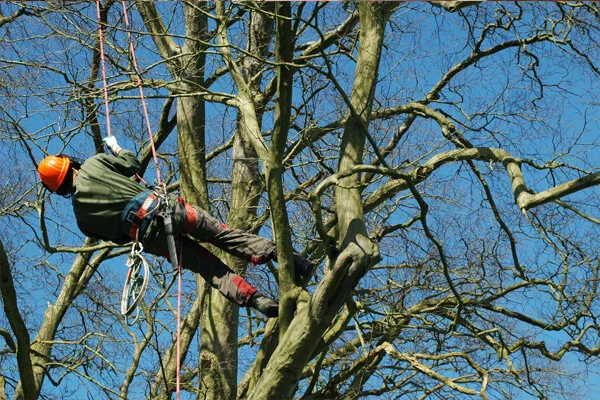
Crews of professionals do not start cutting at once. They prepare the place of operation in a safe way. This includes:
- Installation of traffic cones and warning signs in case of being close to a road.
- Establishing a drop zone for falling trees.
- Installation of rigging pulleys and ropes.
- Bucket trucks or a climbing harness system, depending on the height of the trees.
- Establishing overhead clearance along power lines.
Every crew member wears:
- Hard hats
- Protective eyewear
- Cut-resistant gloves
- Chainsaw-resistant chaps
- Steel-toe boots
In urban areas such as New York City, there is always a lack of room and thus advanced rope rigging methods are necessary to ensure limbs do not destroy adjacent properties. This is a disciplined method and keeps the activities of professionals independent of dangerous DIY cutting.
3. Crown Cleaning: Removing Dead and Hazardous Branches
The first actual trimming phase is typically crown cleaning. This step focuses on removing:
- Dead limbs (brittle, leafless branches)
- Diseased wood
- Broken or storm-damaged branches
- Rubbing or crossing branches
- Weak branch unions with included bark
Each cut is deliberate. Arborists use the three-cut method to prevent bark tearing:
- An undercut several inches from the trunk
- A top cut slightly farther out
- A final clean cut just outside the branch collar
The branch collar is critical—it contains specialized cells that help seal wounds naturally. Cutting too close (flush cut) damages the tree’s defense system. Cutting too far leaves a stub that invites decay.
This step improves safety and restores structural integrity.
4. Crown Thinning for Light and Airflow
After the removal of hazardous limbs, the crew proceeds to the crown thinning. This is not an arbitrary cutting off of branches. It is a strategically downsizing of interior branches to:
- Improve air circulation
- Reduce wind resistance
- Provide increased sunlight penetration.
- Promote balanced growth
Professional thinning preserves the natural form of the tree and also decreases the density of the tree by about 10- 25 percent, depending on the species and health.
Poor thinning is commonly referred to as lion-tailing, which causes excessive interior growth to be removed leaving the foliage at the ends of the branches. This compromises strength of structure. Experienced arborists do not repeat this error by ensuring that branches are distributed evenly.
5. Crown Raising for Clearance
When your trees are too low and are dangling on sidewalks, driveways or buildings, the crew does crown raising.
This entails amputation of lower limbs to attain:
- Pedestrian clearance (8 feet on average)
- Clearance (1014 feet) of vehicles (according to location).
- Roof and gutter protection
- Easy visibility of security cameras or visibility of the streets.
Arborists are however guided by strict guidelines. Excessive cutting of lower branches may make a tree top-heavy, and leave the bark to the injury of sunscald.
This is determined by the diameter of the trunk and structural support.
6. Crown Reduction (If Necessary)
In case the tree has become too big in its location, then crown reduction pruning can be advised.
This is quite contrary to topping.
Reduction pruning includes instead of snipping of the top flat (which is detrimental and produces poor regrowth):
- Shortening branch length
- Reduction to a lateral branch at least a 1/3rd of the diameter of the tipping stem.
- Maintaining natural canopy shape.
Trees near buildings or power facilities should be reduced, and this usually happens to the crown of a tree.
7. Structural Pruning for Young Trees
If the appointment involves a young tree, arborists focus on structural pruning.
This establishes:
- A dominant central leader
- Proper branch spacing
- Strong branch attachment angles (45–60 degrees)
- Balanced scaffold limbs
Correct structural pruning reduces future storm damage risk and minimizes long-term corrective trimming costs.
8. Precision Cutting Tools Used
During the appointment, professionals use specialized tools including:
- Bypass hand pruners for small branches
- Loppers for mid-sized limbs
- Pole saws for elevated cuts
- Gas or battery-powered chainsaws
- Rigging systems and friction devices
- Climbing gear such as saddles and ascenders
Tools are disinfected between cuts when disease is present to prevent pathogen transmission.
9. Debris Management and Cleanup
After trimming, the job isn’t finished. Professional service includes full debris management:
- Branches are lowered carefully using ropes
- Limbs are processed through a wood chipper
- Larger sections are cut into manageable logs
- Sawdust is cleared from lawn and hard surfaces
Homeowners may choose to keep mulch from chipped wood for landscaping use.
The property should look cleaner than before work began.
10. Final Inspection and Client Walkthrough
Before leaving, the arborist performs a final inspection:
- Ensures structural balance
- Confirms proper pruning cuts
- Checks for hanging debris
- Verifies clearance objectives were met
They then walk the property with you, explaining what was done and recommending future maintenance intervals.
Most mature trees benefit from trimming every 2–3 years, though fast-growing species may require annual service.
Conclusion
In order to ensure the protection of the property and the tree, tree trimming involves decades of experience and knowledge of the inner workings of tree anatomy. When trimming is performed correctly, it is proven to increase the value of your property, and ensure the tree grows in a healthy manner and provides the tree with structural support, and increases the overall safety of the area. The only practice that will ensure the continued health of a tree for the duration of it’s life is pruning performed in accordance with proper standards. The only tree care service that provides the level of experience required for the proper care of the trees in your care is NYC Tree Trimming. This is the only service that supports modern, practice based tree care for the urban landscape.